The reason so many AI hires go wrong is that “AI engineer” is not one job. When founders weigh an AI automation specialist vs AI developer vs ML engineer, they are really choosing between three very different skill sets that happen to share a buzzword. Hire the wrong one and you either overpay a senior for plumbing work or hand a hard modeling problem to someone who has only ever called an API.
This breaks down the three roles by what each actually ships, what each costs, and the signal that tells you which one your project needs. There is a fourth role too, the solutions architect, and we will place it at the end.
The short version
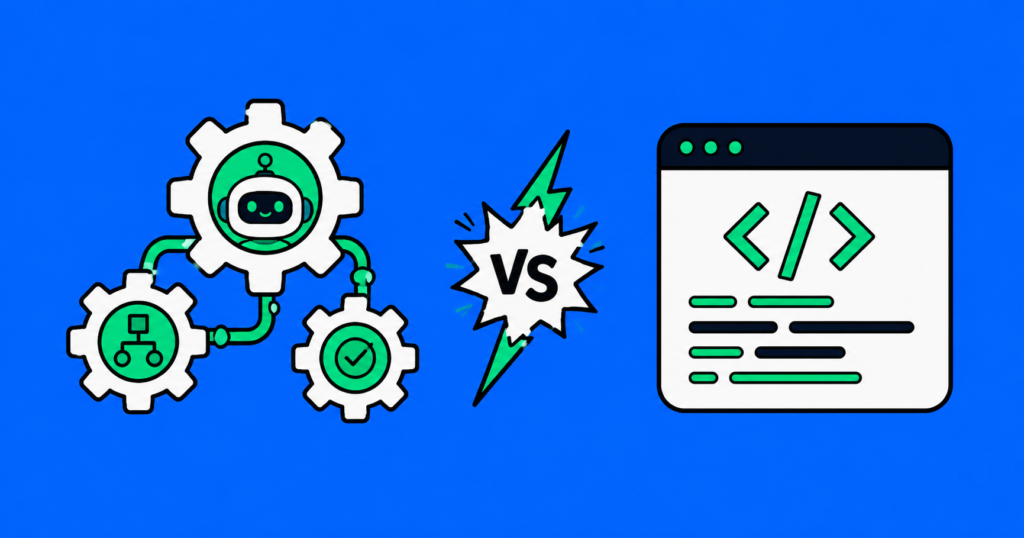
An automation specialist connects things and makes them run without you. An AI developer builds products with AI inside them. An ML engineer creates and deploys custom models. The roles climb in depth, scarcity, and cost in that order, and most companies need the first or second long before they need the third.
| Role | What they ship | Typical offshore rate |
|---|---|---|
| AI automation specialist | Workflows, agents, integrations | $15/hr |
| AI developer | Full-stack apps with embedded AI | $20/hr |
| ML engineer | Custom models, training, MLOps | $25/hr |
AI automation specialist: the one most teams need first
An automation specialist removes manual work. They live in tools like n8n, Make, and Zapier, plus the OpenAI and Claude APIs, and they wire your systems together so data moves and actions happen without a human in the loop.
What they ship is concrete: multi-step workflows across your CRM, email, Slack, and spreadsheets; AI agents and chatbots that answer questions and take actions; API connections and webhooks; and light scripting to cover the gaps no pre-built tool fills. The value is leverage. One strong automation specialist can absorb the busywork that would otherwise justify a part-time hire, and the system keeps working after they build it.
Hire this role when your bottleneck is operations. If your team spends ten or more hours a week copying data between apps, chasing manual handoffs, or doing the same sequence of clicks every day, this is the highest-return hire you can make, and it is the most affordable tier.
AI developer: when you are building a product, not automating around one
An AI developer is a full-stack engineer who ships applications with intelligence built in. Where the automation specialist connects existing tools, the developer builds new ones.
What they ship: web apps in React, Next.js, Node, and Python or FastAPI; mobile apps in React Native or Flutter; and embedded AI features like chat, search, summarization, and retrieval-augmented generation over your own content. They handle authentication, payments, and deployment on Vercel, AWS, or GCP. This is the person who turns “we should have an AI feature” into a thing your users actually log into.
Hire this role when AI is inside the product, not just around it. If you are a SaaS founder adding a copilot, a startup shipping an AI-native app, or a team embedding an LLM feature customers will touch, you need a developer who can architect, build, and deploy a real application, not just connect APIs.
ML engineer: when off-the-shelf models are not enough
An ML engineer works a layer deeper. According to IBM, machine learning is about systems that learn patterns from data rather than following fixed rules, and an ML engineer is the person who builds, trains, and operates those systems in production.
What they ship: custom model training and fine-tuning, both modern transformers and classical machine learning; retrieval pipelines and vector database architecture; model deployment, monitoring, and the MLOps that keeps a model healthy after launch; and specialized work in computer vision, natural language processing, and recommendation systems. This is the senior, scarce, and therefore more expensive tier.
Do I need an ML engineer? Ask one question: are the off-the-shelf APIs enough? If a general model from OpenAI or Anthropic, pointed at your data through good retrieval, solves your problem, you do not need to train anything, and an AI developer can deliver it. You need an ML engineer when you require a model trained on proprietary data, deployed on your own infrastructure, and monitored in production, usually because accuracy, privacy, or a specific domain demands it.
How to pick: a simple decision path
You can usually settle the AI automation specialist vs AI developer question, and the ML engineer question, with three checks.
Start with the bottleneck. If it is manual operations and disconnected tools, hire the automation specialist. If it is a product you need to build or extend, hire the developer. If it is model accuracy on your own data that generic APIs cannot reach, hire the ML engineer.
Then check the deliverable. A workflow that runs your ops is automation. An app your customers log into is development. A trained model deployed on your infrastructure is ML engineering.
Then check the budget against the value. Automation is the cheapest and fastest to a return because it removes cost immediately. Development is an investment in a product. ML engineering is the deepest commitment and pays off when a custom model is genuinely the unlock.
Most teams move through these in order. They automate operations first, build product second, and only train custom models once they have the scale and data to justify it.
The fourth role: solutions architect
There is one more type of AI engineer worth knowing. A solutions architect does not primarily build. They scope and design. When you are planning an enterprise pilot, a customer-facing AI product, or a multi-quarter initiative, the architect selects the tools, designs the system, reviews security and compliance, and writes the technical roadmap before anyone writes code. You bring them in at the start of something serious, so the expensive build happens once, correctly.
At Ad Snipper, all four roles, automation specialist, AI developer, ML engineer, and solutions architect, are available as dedicated placements at flat hourly rates from $15 to $25 an hour. You can see all four AI hiring tiers and pricing and match the role to the work rather than overpaying for a title.
FAQ
What is the difference between an AI automation specialist and an AI developer?
An automation specialist connects existing tools and builds workflows and agents in platforms like n8n. An AI developer builds full applications with AI features inside them. Automation removes manual work; development creates new product.
Do I need an ML engineer for my AI project?
Only if off-the-shelf models are not enough. If a general API plus good retrieval over your data solves the problem, an AI developer can deliver it. You need an ML engineer to train and deploy a custom model on proprietary data.
Which AI role is the most affordable to hire?
The automation specialist, typically around $15 an hour offshore. It is also often the fastest to a return, because it removes operational cost right away.
Can one person cover all three roles?
Rarely well. Some generalists span automation and development, but custom model training is a distinct discipline. Match the hire to the actual deliverable instead of hoping for a unicorn.
What are the main types of AI engineers?
Four common ones: automation specialists, AI developers, ML engineers, and solutions architects. They differ in what they ship, the depth required, and the rate, from connecting tools up to designing enterprise systems.
Frequently asked questions
What is the difference between an AI automation specialist and an AI developer?
An automation specialist connects existing tools and wires up no-code and low-code workflows (n8n, Make, Zapier, GoHighLevel). An AI developer builds real software from scratch, apps, RAG systems, and custom agents on LLM APIs. Automation is plumbing between products; development is building the product.
Do I need an AI automation specialist or a full AI developer?
If your problem is that your tools do not talk to each other, or a manual task should run itself, you need an automation specialist (from $15/hour). If you are building an app, a custom agent, or anything users log into, you need an AI developer (from $25/hour). When unsure, scope it on a call.
Can one person do both automation and development?
Some can, but the rates and skill sets differ, so you rarely want to pay a developer’s rate for automation work or ask an automation specialist to architect a SaaS product. Match the tier to the job, which is exactly how our three AI engineer tiers are structured.
Related reading: Hire an AI agent developer.