Quick answer
An AI automation agency builds and maintains automated workflows for clients on tools like n8n, Make, Zapier, and GoHighLevel, with LLM steps wired in. You sell a setup fee (roughly $2,500 to $15,000 per build) plus a monthly retainer ($1,500 to $5,000) to monitor and improve the system. The hard part is not sales, it is delivery: you can only build so many workflows yourself before you become the bottleneck. The fix is embedded offshore automation specialists at $15/hour who ship under your brand, so you scale output and protect margin without hiring locally.
The pitch for an AI automation agency is easy to fall in love with. Software margins, recurring revenue, almost no inventory, and a market that is growing faster than you can keep up with. The reality is more specific. Demand is real and rising, but it has matured. Clients are done paying you to “explore AI.” They want a real business process automated, with a clear before and after. That shift is good for you if you can deliver, and brutal if you cannot.
This is an operator’s guide to the model in 2026: what the work actually is, how to price it, where the wall is, and how to get past it without torching your margin or your evenings.
What an AI automation agency actually does
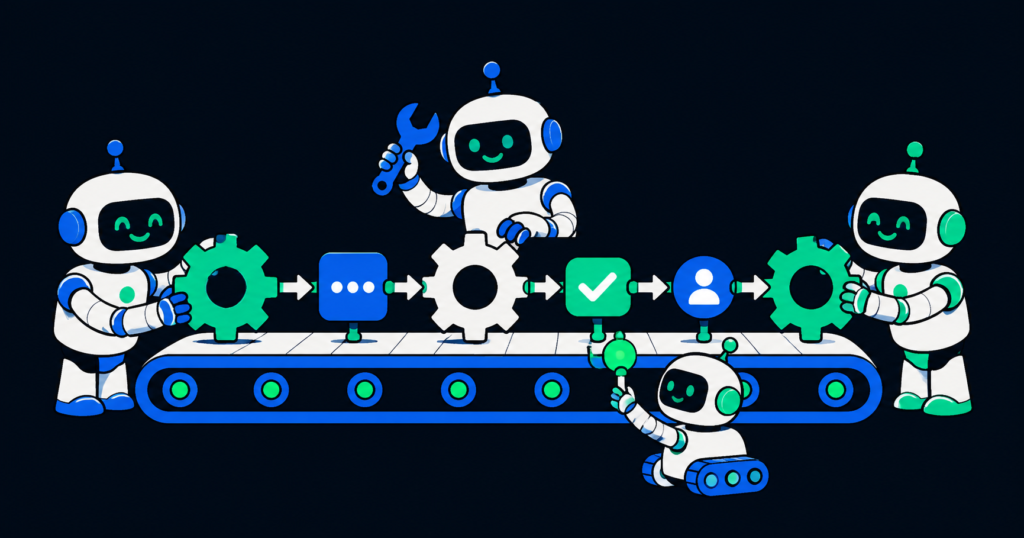
Strip away the branding and the job is plumbing. You connect a client’s tools so that work that used to be manual now happens on its own. A lead fills a form, the system enriches the record, scores it, drops it into the CRM, fires a personalized follow up, and books the call. No human touches it until the call is on the calendar.
The build sits on a handful of platforms, and each has a clear use case:
- Zapier. Broadest SaaS connectivity and the fastest path to a working flow. Good for clients who live in mainstream apps and want speed over control.
- Make. Strong visual builder at a competitive price. The default when a flow has branching logic that would get ugly in Zapier.
- n8n. Self hosted and cost efficient at volume. This is where serious agencies make margin, because you are not paying per task once execution counts climb.
- GoHighLevel. CRM plus automation built for service businesses. The natural fit when the client is an agency, a clinic, or a local services brand.
The “AI” part is the LLM steps you wire into those flows: a model that drafts the reply, classifies the ticket, summarizes the call, extracts fields from a messy PDF, or decides which branch to take. The platform moves the data. The model makes the judgment. Your value is knowing which judgment is worth automating and building it so it does not fall over in production.
That last point is where most operators get caught. As one automation team put it bluntly, if your workflow breaks at 100 executions, you have not built automation, you have built a demo (Goodspeed, 2026). Clients are paying for the version that survives Monday morning at scale, not the one that looked great in the sales call.
The demand is real, and it has changed shape
The numbers are not subtle. The global AI automation market was valued at roughly $129.92 billion in 2025 and is projected to grow at a 31.4% CAGR through 2033 (Grand View Research). On the ground, around 38% of small and mid sized businesses had adopted some form of AI automation by 2026, with an estimated 50% of SMBs expected to run at least one AI powered workflow by 2027 (Orbilon, 2026).
But the type of demand has shifted. Buyers have moved past experimentation. The market is moving toward workflow redesign, system integration, governance, and production rollout, while interest in “help us try AI” cools and “help us automate a real process with clear ROI” grows fast (Wazobia, 2026). Translation: the easy demos are over. The money is in builds that work and keep working, which is exactly the kind of delivery that does not scale off one person’s hands.
How to price it: setup plus retainer
The model that holds up is a setup fee to build, then a retainer to run. The setup fee covers the project. The retainer covers the part nobody likes to talk about: a live system needs a human watching it.
Real 2026 ranges from agencies publishing their numbers:
- Setup or build fees: roughly $2,500 for a standard workflow up to $15,000 or more for a production grade stack with multiple integrations and AI components (Arsum, 2026). Larger migrations and full automation stacks reach $35,000 and up (Goodspeed, 2026).
- Monitoring retainers: commonly $500 to $5,000 per month, with system support retainers landing $2,000 to $8,000 depending on complexity (Arsum, 2026).
The retainer is not padding. If a competent agency nets 25% to 35% on a retainer, the rest is buying the client a maintained system, a human watching it, and someone accountable when it breaks (Automaton, 2026). That accountability is labor, it is expensive, and it does not go away. One useful play: launch on a project fee, then convert the client to a retainer once the automation is live and proving value. You de risk the first cheque and earn the recurring one.
One more market reality to price against. AI automation pricing dropped roughly 35% between 2024 and 2026 as open source models matured and platforms competed (Arsum, 2026). You cannot win on price alone going forward. You win on delivery speed and reliability, which loops straight back to capacity.
The wall every agency hits: delivery
Here is the trap. Sales is solvable. You can run cold email, post on LinkedIn, and book calls. Delivery is the constraint. A workflow takes real hours to scope, build, test against edge cases, and harden for production. You, the founder who can actually do this, are also the person selling, supporting, and running the business. Every new client you close eats the exact hours you need to deliver the last one.
So you reach the obvious next step, hire a builder. And the local math stops you cold. A mid to senior automation engineer in the US runs roughly $107,000 to $156,000 in base salary, and fully loaded at 1.25x to 1.4x that base lands around $162,000 to $182,000 a year, call it $13,500 to $15,000 a month before they ship a single automation (Agix, 2026). On a stack of $2,000 retainers, one local hire can wipe out the margin from several clients at once.
This is the moment most agencies stall. They cap client count at whatever the founder can personally deliver, and the business never becomes a business. It stays a high paying job with a ceiling.
How offshore builders break the bottleneck
The unlock is decoupling who sells from who builds, and putting the build work where the cost structure makes sense. Skill in n8n, Make, and prompt engineering is global. Salaries are local. An automation specialist in Pakistan does the same work as one in California at a fraction of the loaded cost, and you keep the spread.
The model is not a faceless dev shop you hand a ticket to and pray. It is an embedded automation specialist who works inside your delivery process, on your tools, under your brand. The client sees your agency. You see capacity. This is AI staff augmentation, not outsourcing the relationship.
At Ad Snipper, an embedded AI automation specialist is $15 per hour, $2,400 per month full time or $1,200 per month part time. They are dedicated to you, white labeled, and they go through vetting and onboarding before they touch a client account, with free replacement if the fit is wrong. Run the margin. If a specialist builds and maintains the workflows behind four $2,500 retainers, your monthly delivery cost is $2,400 against $10,000 in recurring revenue. That is the difference between a capped freelancer and an agency that scales.
| Delivery option | Real monthly cost | What you get | Scaling ceiling |
|---|---|---|---|
| Do it yourself | Your time only | Full control, every build is on you | Hard cap at founder hours; growth stalls fast |
| In-house US hire | $13,500 to $15,000 fully loaded (Agix, 2026) | On-site senior engineer, full overhead | Margin eaten by salary; risky on small retainers |
| Embedded offshore builder (Ad Snipper) | $2,400 full time, $1,200 part time | Dedicated, vetted, white-label specialist on your tools | Add specialists as client count grows; margin protected |
A practical playbook to start or scale
Whether you are at zero or stuck at the founder ceiling, the sequence is the same.
1. Pick a narrow service and a niche
Do not sell “AI automation.” Sell one outcome to one type of business. Lead follow up automation for real estate teams. Support ticket triage for ecommerce brands. A tight niche makes your sales message obvious and lets you reuse builds across clients, which is where delivery efficiency comes from.
2. Standardize your builds
Turn your best workflows into templates. A specialist can clone and adapt a proven template far faster than building from scratch, and reuse is what turns a $15/hour builder into pure leverage.
3. Sell setup plus retainer from day one
Never sell a one time build with no follow on. Price the project, then move the client onto monitoring. Recurring revenue is the whole point of the model and the thing that makes your business worth something.
4. Embed a builder before you are drowning, not after
The mistake is waiting until you are buried to add capacity. Bring on a part time specialist at $1,200 a month while you still have headroom, hand off the repeatable builds, and free yourself for scoping and sales. Scale to full time and add AI engineers for heavier custom work as the pipeline grows.
5. Keep the human in the loop
Production automations need someone watching. Bake that into the retainer and staff it with your embedded specialist. That is the part clients pay for and the part that keeps them paying.
Further reading: See the current 2026 AI developer hourly rates.
Frequently asked questions
Do I need to be technical to run an AI automation agency?
You need to understand the workflows well enough to scope them and talk to clients, but you do not have to be the one building at scale. Many successful operators sell and manage the relationship while embedded specialists handle the build. The skill that matters most is knowing which processes are worth automating and what “done right” looks like in production.
How much can an AI automation agency actually make?
The margin lives in the gap between what clients pay and what delivery costs. A stack of four $2,500 monthly retainers is $10,000 in recurring revenue. If an embedded specialist at $2,400 a month builds and maintains them, the delivery cost is fixed and the margin scales as you add clients. The constraint is not demand, it is whether you can deliver without becoming the bottleneck yourself.
Why offshore instead of hiring locally or using freelancers?
A fully loaded US automation engineer runs $13,500 to $15,000 a month (Agix, 2026), which can erase the margin on a handful of retainers. Random freelancers are cheaper but inconsistent and not embedded in your process. A dedicated, vetted, white-label specialist at $15 per hour gives you reliable capacity inside your brand at a cost structure that lets you keep the spread.
What does “embedded and white-label” mean for my clients?
Your clients never know the build was done offshore. The specialist works on your tools, in your delivery process, under your agency’s name. They are dedicated to you rather than juggling other accounts, go through vetting and onboarding before touching client work, and come with free replacement if the fit is wrong. To the client, it is simply your team delivering.
Related reading: Is an AI automation agency worth it?.